Architectural Patterns for Modern Data Platforms
Introduction
In today’s data-driven world, choosing the right data architecture is crucial for organizational success. Data architecture defines how data is collected, stored, processed, and accessed across an organization. The evolution of data architectures has been driven by increasing data volumes, velocity, variety, and the need for real-time insights.
This guide explores the major data architecture patterns, their strengths, weaknesses, and ideal use cases. Each architecture represents different trade-offs between complexity, cost, flexibility, and performance.
Table of Contents
1. Traditional Data Warehouse Architecture
Overview
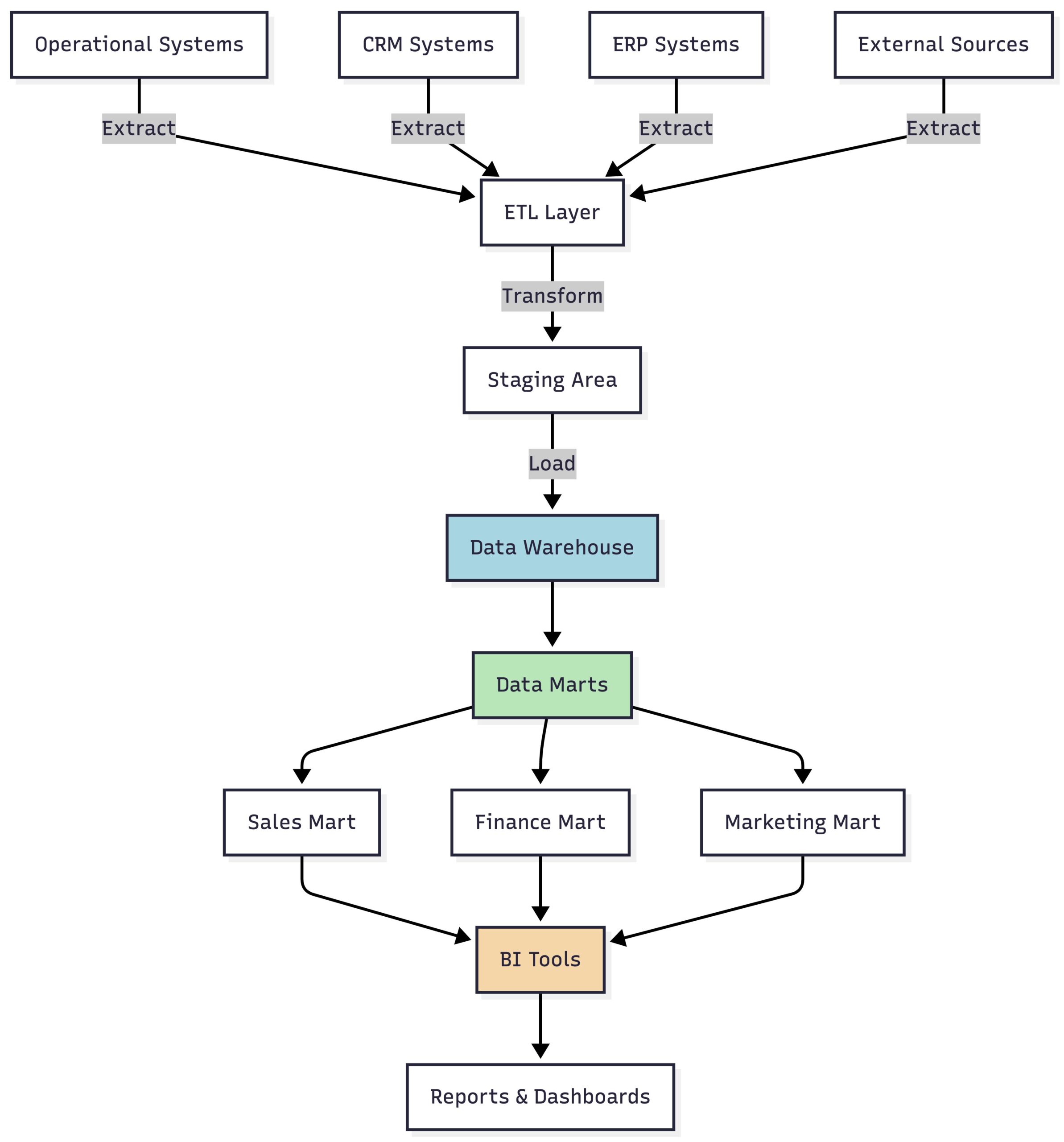
The Traditional Data Warehouse is the foundational architecture that has served enterprises for decades. It follows a structured, schema-on-write approach where data is extracted from source systems, transformed to fit a predefined schema, and loaded into a centralized repository optimized for analytical queries.
Key Characteristics
- Schema-on-Write: Data is structured before storage
- ETL Process: Extract, Transform, Load pipeline
- Centralized Storage: Single source of truth
- OLAP Optimization: Optimized for analytical processing
- Structured Data: Primarily handles relational data
- Historical Analysis: Strong focus on historical reporting
Advantages
- Data Quality: Strong governance and data quality controls
- Performance: Optimized for complex analytical queries
- Maturity: Well-established best practices and tooling
- Business Intelligence: Excellent for traditional BI and reporting
- ACID Compliance: Strong transactional guarantees
Disadvantages
- Rigidity: Schema changes are difficult and time-consuming
- Cost: Expensive storage and compute resources
- Scalability: Limited horizontal scalability
- Data Types: Struggles with unstructured and semi-structured data
- Latency: Not suitable for real-time analytics
Best Use Cases
- Financial reporting and compliance
- Enterprise business intelligence
- Historical trend analysis
- Regulatory reporting requirements
- Organizations with stable data requirements
2. Data Lake Architecture
Overview
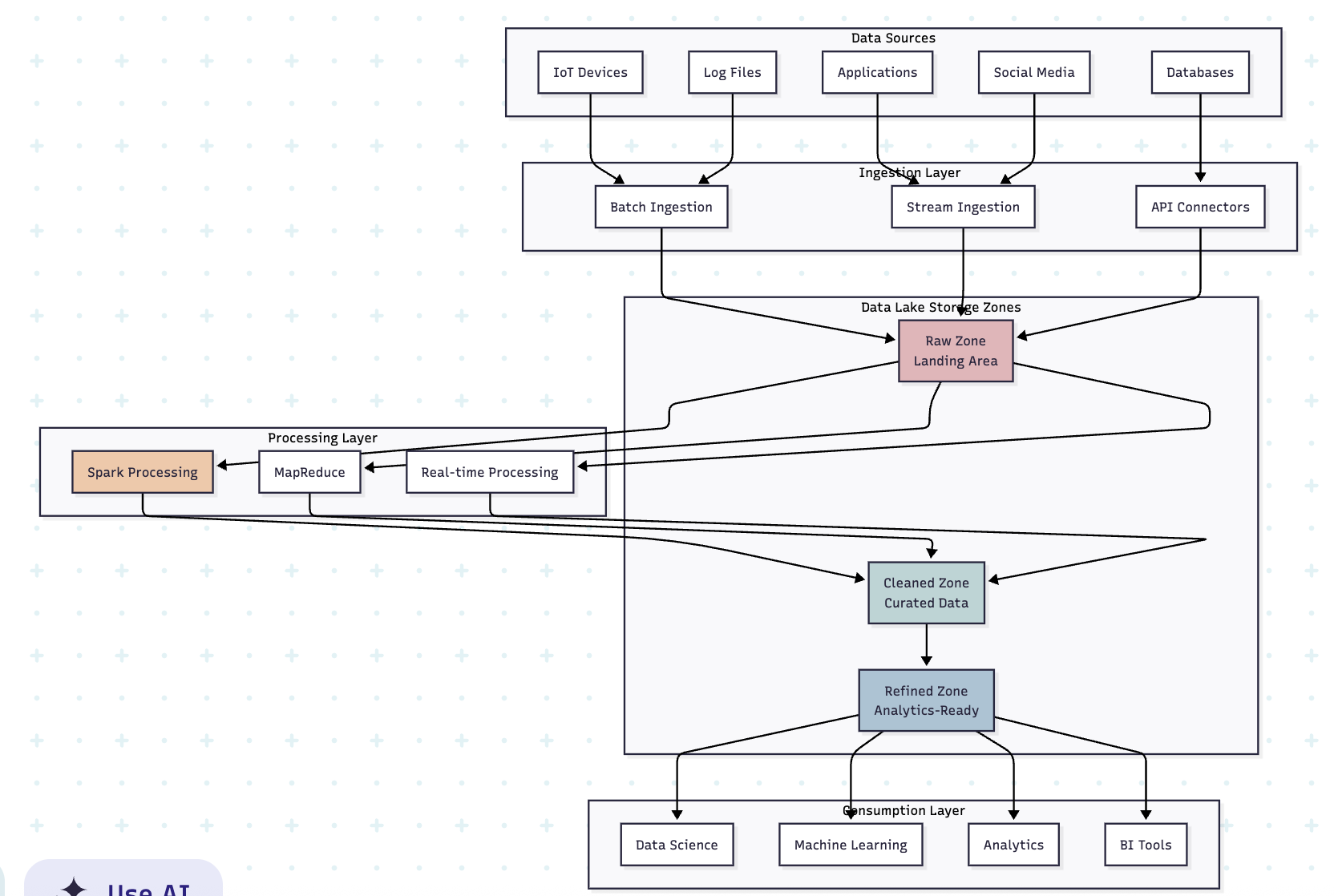
Data Lakes emerged to address the limitations of traditional warehouses in handling large volumes of diverse data types. This architecture stores raw data in its native format, applying schema-on-read principles where structure is applied only when data is accessed.
Key Characteristics
- Schema-on-Read: Structure applied during analysis
- Raw Data Storage: Data stored in native format
- Scalability: Horizontal scaling using distributed storage
- Variety: Handles structured, semi-structured, and unstructured data
- Cost-Effective: Uses commodity hardware and object storage
- Flexibility: Supports multiple processing paradigms
Advantages
- Flexibility: Store any type of data without predefined schema
- Scalability: Virtually unlimited storage capacity
- Cost-Effective: Lower storage costs using object storage
- Innovation: Enables data exploration and experimentation
- Future-Proofing: Raw data preserved for future use cases
Disadvantages
- Data Swamp Risk: Can become disorganized without proper governance
- Performance: Query performance can be slower than warehouses
- Complexity: Requires specialized skills for data processing
- Data Quality: Schema-on-read can lead to quality issues
- Security: Challenging to implement fine-grained access control
Best Use Cases
- Machine learning and AI initiatives
- Big data analytics
- IoT data processing
- Data exploration and experimentation
- Organizations with diverse data sources
3. Data Lakehouse Architecture
Overview
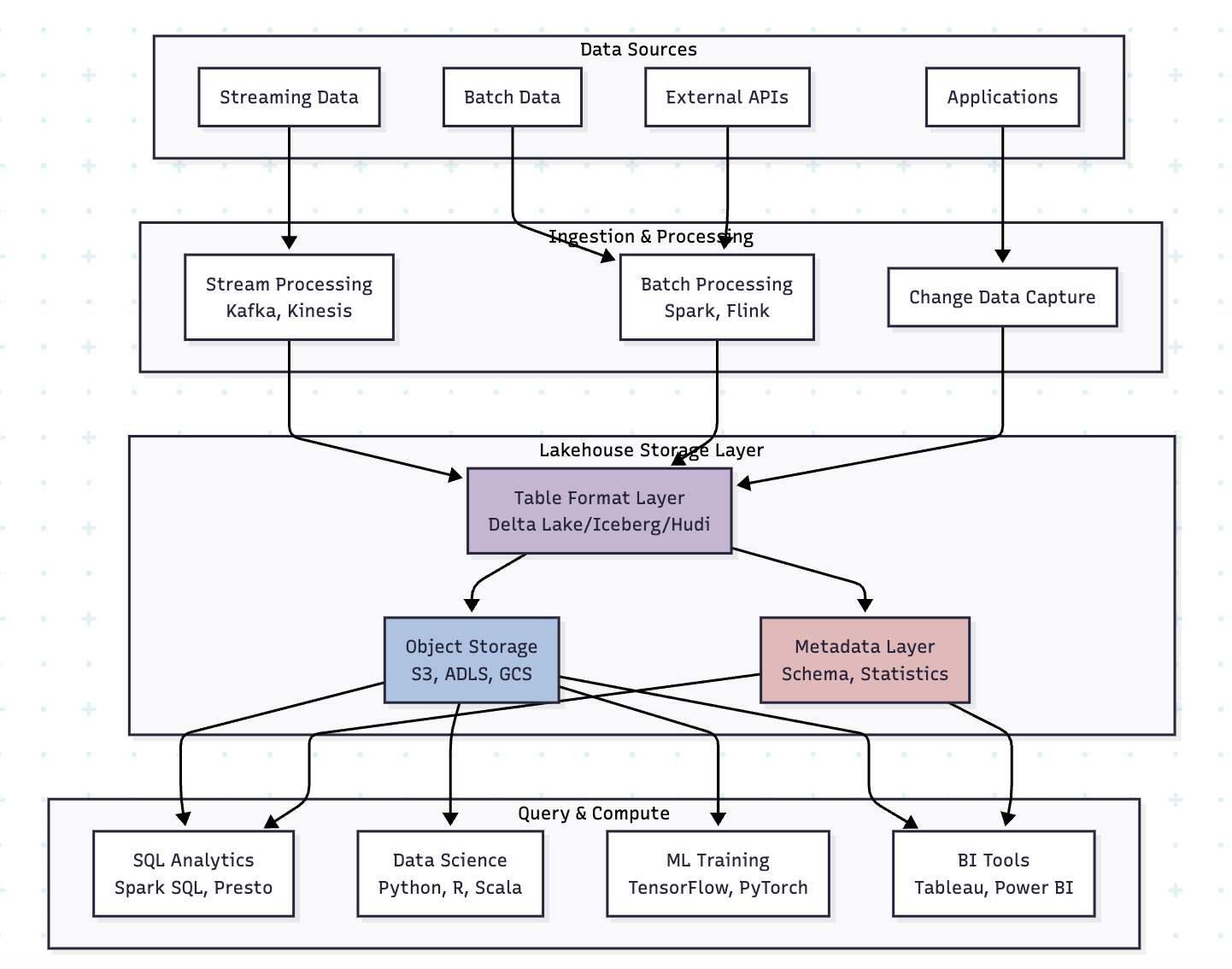
The Data Lakehouse is a modern architecture that combines the best features of data warehouses and data lakes. It provides the flexibility and cost-effectiveness of data lakes with the structure and performance of data warehouses through technologies like Delta Lake, Apache Iceberg, and Apache Hudi.
Key Characteristics
- Unified Platform: Single platform for all data workloads
- ACID Transactions: Transaction support on lake storage
- Schema Evolution: Flexible schema management
- Time Travel: Query historical versions of data
- Performance: Warehouse-like query performance
- Open Formats: Based on open table formats
Advantages
- Best of Both Worlds: Combines warehouse reliability with lake flexibility
- Cost-Effective: Lower storage costs than traditional warehouses
- ACID Support: Reliable transactions and consistency
- Unified Architecture: Single platform reduces complexity
- Performance: Optimized for both batch and streaming
- Time Travel: Query historical data states
Disadvantages
- Emerging Technology: Less mature than traditional options
- Complexity: Requires understanding of distributed systems
- Vendor Lock-in: Some implementations tied to specific platforms
- Learning Curve: New concepts and tools to master
Best Use Cases
- Organizations modernizing data infrastructure
- Combined BI and ML workloads
- Real-time and batch analytics on same platform
- Companies seeking to reduce architecture complexity
- Cloud-native data platforms
4. Lambda Architecture
Overview
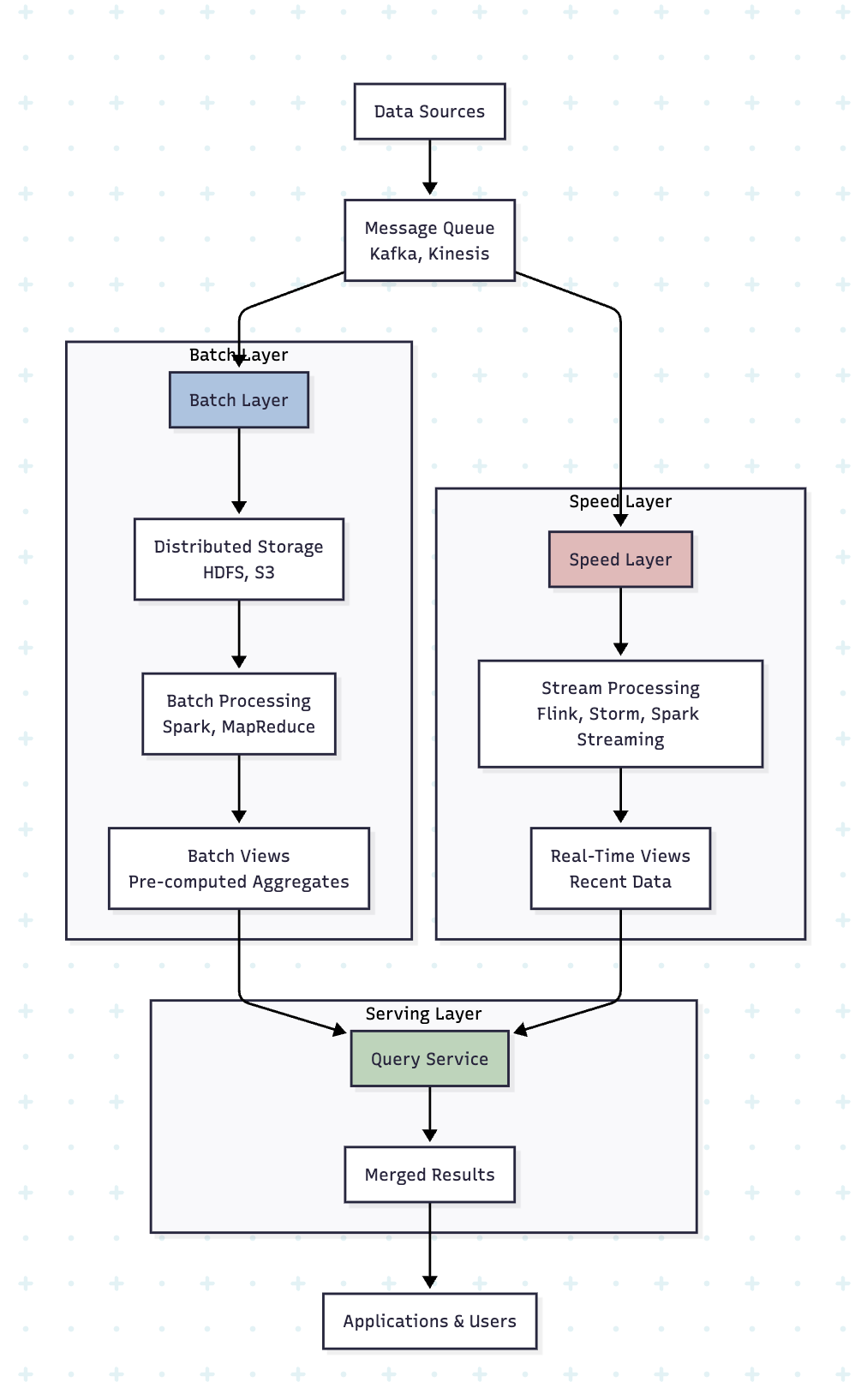
Lambda Architecture is designed to handle massive quantities of data by using both batch and stream processing methods. It provides a robust, fault-tolerant system that can handle real-time queries while maintaining accuracy through batch reprocessing.
Key Characteristics
- Dual Processing: Separate batch and speed layers
- Fault Tolerance: Batch layer ensures eventual accuracy
- Real-Time Insights: Speed layer provides low-latency results
- Immutable Data: Append-only master dataset
- Reprocessing: Ability to recompute views from scratch
Advantages
- Fault Tolerance: Errors in speed layer corrected by batch layer
- Scalability: Both layers can scale independently
- Accuracy: Batch processing ensures eventual correctness
- Real-Time: Speed layer provides immediate insights
- Flexibility: Different technologies for different needs
Disadvantages
- Complexity: Maintaining two processing pipelines
- Duplication: Same logic implemented twice
- Operational Overhead: More components to manage
- Development Cost: Higher development and maintenance effort
- Consistency: Potential for temporary inconsistencies
Best Use Cases
- Real-time analytics with accuracy guarantees
- Large-scale event processing
- Systems requiring both speed and accuracy
- Mission-critical applications needing fault tolerance
- High-volume data processing scenarios
5. Kappa Architecture
Overview
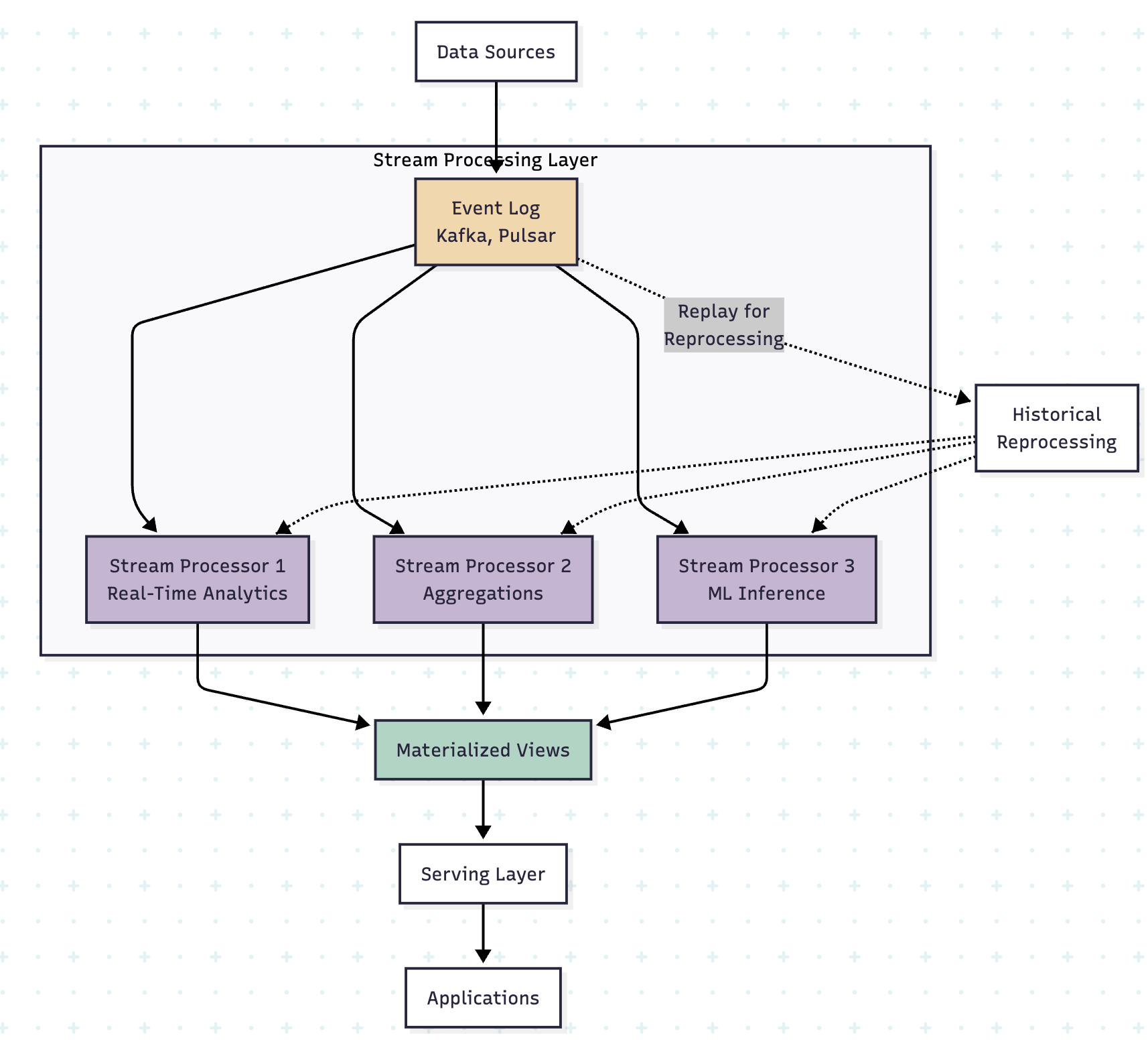
Kappa Architecture is a simplification of Lambda Architecture that eliminates the batch processing layer. It uses a single stream processing engine to handle both real-time and historical data processing, treating everything as a continuous stream.
Key Characteristics
- Single Pipeline: One codebase for all processing
- Stream-First: Everything treated as a stream
- Reprocessing: Historical data reprocessed via replay
- Simplicity: Reduced architectural complexity
- Event Sourcing: Events as the source of truth
Advantages
- Simplicity: Single processing paradigm
- Maintainability: One codebase to maintain
- Consistency: No synchronization between layers
- Flexibility: Easy to reprocess data
- Real-Time First: Optimized for streaming workloads
Disadvantages
- Reprocessing Speed: Slower than Lambda’s batch layer
- Storage Requirements: Need to retain event history
- Stream Processing Complexity: Everything must work in streaming
- Tooling Maturity: Fewer mature tools than batch processing
- Operational Complexity: Stream processing can be challenging
Best Use Cases
- Event-driven architectures
- Real-time analytics platforms
- Systems with frequent logic changes
- Microservices architectures
- Organizations prioritizing simplicity
6. Modern Data Stack
Overview
The Modern Data Stack represents a cloud-native approach to data architecture, leveraging SaaS and managed services. It emphasizes modularity, enabling organizations to assemble best-of-breed tools for ingestion, storage, transformation, and analysis.
Key Characteristics
- Cloud-Native: Built for cloud platforms
- ELT over ETL: Load first, transform in warehouse
- Modularity: Best-of-breed tool integration
- SQL-Based: SQL as primary transformation language
- Git-Based Workflows: Version control for transformations
- Self-Service: Empower analysts and data teams

Advantages
- Speed to Value: Quick setup and deployment
- Managed Services: Reduced operational overhead
- Scalability: Cloud-native scaling
- Cost Efficiency: Pay-as-you-go pricing
- Innovation: Rapid adoption of new features
- Analyst-Friendly: SQL-based, accessible tools
Disadvantages
- Vendor Lock-in: Dependency on multiple vendors
- Cost Unpredictability: Usage-based pricing can scale
- Data Movement: Multiple data transfers between services
- Customization Limits: Less control than self-hosted
- Compliance: May have regulatory constraints
Best Use Cases
- Startups and SMBs
- Organizations moving to cloud
- Analytics-focused teams
- Fast-growing companies
- Teams without large data engineering resources
7. Data Mesh Architecture
Overview
Data Mesh is a paradigm shift that treats data as a product and applies domain-driven design principles. Rather than centralizing data in a monolithic platform, Data Mesh advocates for a decentralized, domain-oriented approach where domain teams own their data products.
Key Characteristics
- Domain Ownership: Domains own their data
- Data as a Product: Product thinking applied to data
- Self-Service Platform: Federated governance
- Federated Computational Governance: Automated policy enforcement
- Decentralization: Distributed architecture

Advantages
- Scalability: Scales organizationally and technically
- Domain Expertise: Domain teams know their data best
- Autonomy: Teams work independently
- Reduced Bottlenecks: No central data team bottleneck
- Innovation: Domains can innovate independently
Disadvantages
- Complexity: Organizational transformation required
- Duplication: Potential for duplicated effort
- Coordination: Cross-domain coordination challenging
- Maturity: Emerging approach with fewer case studies
- Cultural Change: Requires significant mindset shift
Best Use Cases
- Large enterprises with multiple domains
- Organizations with domain-driven architecture
- Companies facing data team bottlenecks
- Mature organizations ready for transformation
- Distributed teams and products
Comparison Table
Comparison Table
| Architecture | Best For | Complexity | Scalability | Real-Time | Cost | Maturity |
|---|---|---|---|---|---|---|
| Traditional Warehouse | BI & Reporting | Medium | Low | No | High | Very High |
| Data Lake | Big Data & ML | High | Very High | Partial | Low | High |
| Data Lakehouse | Unified Analytics | Medium-High | Very High | Yes | Medium | Medium |
| Lambda | Real-Time + Accuracy | Very High | High | Yes | High | Medium |
| Kappa | Event-Driven | High | High | Yes | Medium | Medium |
| Modern Data Stack | Cloud Analytics | Low-Medium | High | Partial | Medium | Medium |
| Data Mesh | Enterprise Scale | Very High | Very High | Varies | High | Low |
Choosing the Right Architecture
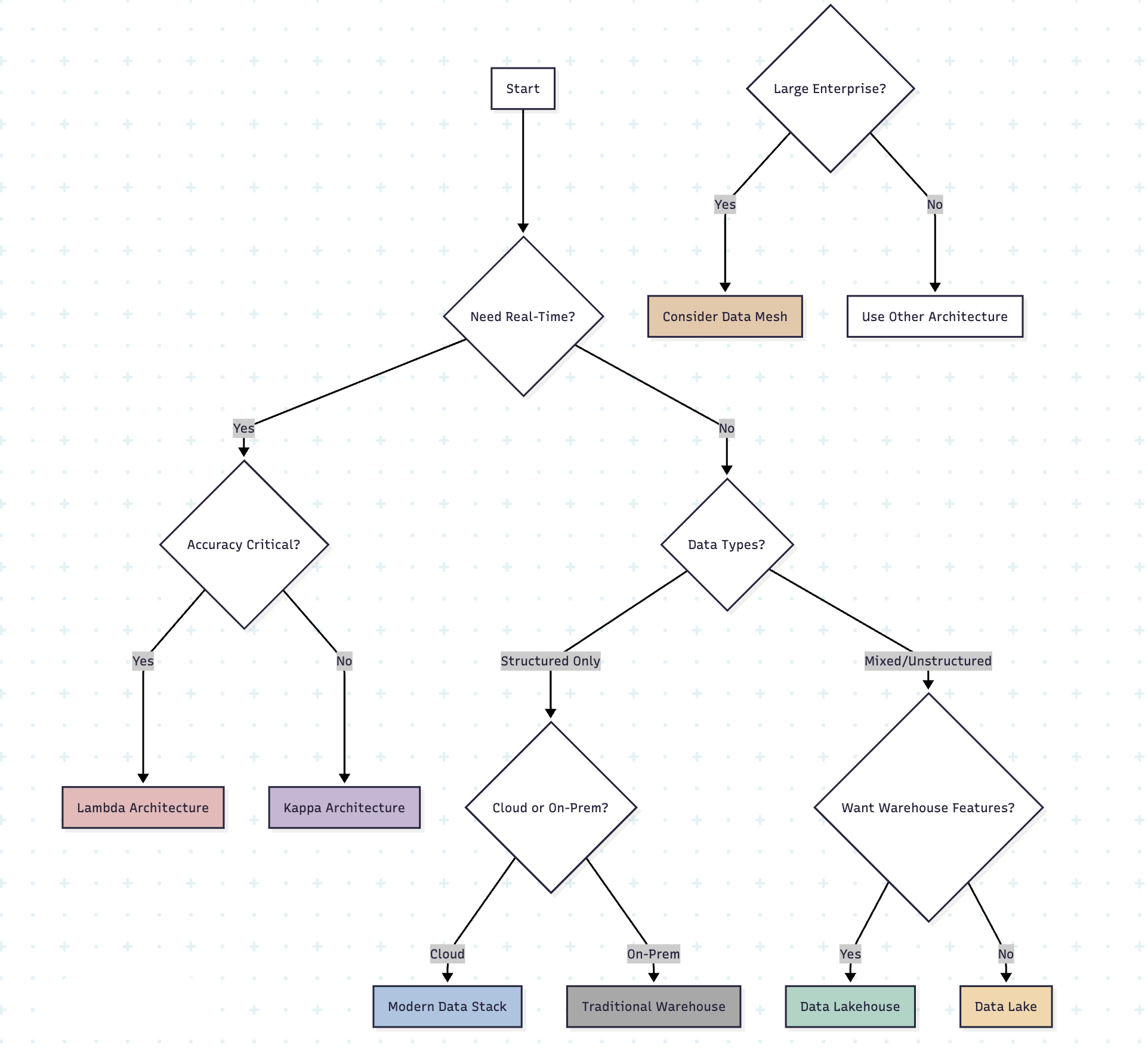
Selecting the appropriate data architecture depends on multiple factors:
Consider These Questions:
- Data Volume: How much data to be processed daily?
- Data Variety: What types of data needs to be handled?
- Latency Requirements: Are real-time insights needed?
- Team Skills: What is the team expertise?
- Budget: What are the cost constraints?
- Organizational Structure: What is the organization structure?
- Compliance: What are the regulatory requirements?
- Growth Trajectory: How fast is the data growing?
Decision Framework
Conclusion
The landscape of data architectures continues to evolve rapidly, driven by increasing data volumes, cloud adoption, and the demand for real-time insights. There is no one-size-fits-all solution; each architecture represents different trade-offs:
- Traditional Data Warehouses remain relevant for structured, compliance-focused workloads
- Data Lakes provide flexibility for exploration and diverse data types
- Data Lakehouses emerge as the unified future for many organizations
- Lambda and Kappa architectures address real-time processing needs
- Modern Data Stack enables rapid cloud-based analytics
- Data Mesh represents organizational scalability for large enterprises
The trend is toward more flexible, cloud-native, and decentralized architectures. Many organizations adopt hybrid approaches, combining elements from multiple architectures to meet their unique requirements.
As these options are assessed, it is important to consider specific requirements, existing constraints, and the organization’s level of readiness. Begin by clearly defining data use cases, then select an architecture that aligns with both technical capabilities and business goals. Data architectures are not fixed and should be reviewed and adapted as requirements evolve and technologies advance.